If you're looking at a LiFePO4 battery for camping, deciding to go lithium is usually the easy part. The harder question is whether you actually need 100Ah, 200Ah, 300Ah or more. A fridge-and-lights setup is one thing; add Starlink, an inverter, cooking gear and a few days parked up and the numbers change quickly. Here's a practical way to size it without just buying the biggest battery bank you can fit.
Why 100Ah of lithium isn't the same as 100Ah of AGM
The number on the battery doesn't tell you how much of it you should plan to use. AMP'D works on roughly 50% usable capacity for AGM and about 85% for LiFePO4. On that basis, a 100Ah AGM gives you around 50Ah to work with, while a 100Ah LiFePO4 gives you about 85Ah.
That's a big difference before you even get to the weight saving. It's also why swapping an AGM bank for lithium doesn't always mean replacing it with the same number of amp-hours. The AMP'D calculator accounts for the different usable capacity when it sizes the battery.
100Ah vs 200Ah vs 300Ah LiFePO4 for camping
| Battery bank | Planned usable capacity* | A sensible starting point for |
|---|---|---|
| 100Ah LiFePO4 | ~85Ah | Fridge, lights, phones and modest overnight loads |
| 200Ah LiFePO4 | ~170Ah | Longer stays, larger fridges, Starlink or moderate inverter use |
| 300Ah LiFePO4 | ~255Ah | Higher daily loads, longer autonomy or regular inverter appliances |
*Using AMP'D's 85% LiFePO4 planning depth-of-discharge assumption. Your battery manufacturer's limits take priority.
Treat that table as a starting point, not a shopping list. A 100Ah battery that gets properly recharged every day can work better on the road than a 200Ah bank that never gets enough solar or driving time. What matters is how many Ah you use, how long you stay parked and how you're going to replace the energy.
Put the fridge, lights, Starlink, inverter appliances and the way you travel into the 12V calculator. It adds up the daily load first, then works out the battery and charging around it.
When 100Ah LiFePO4 is enough
There's nothing wrong with a simple 100Ah setup. If the main load is a compressor fridge, with lights, phones and a water pump around it, 100Ah lithium can be plenty for a vehicle that gets driven or sees decent solar regularly.
Where it gets tight is when you stop moving. A couple of cloudy days, a hot fridge working hard or one extra high-use appliance can eat through the spare capacity quickly. If the fridge is your main concern, we've broken down how long a 100Ah battery can run a 12V fridge separately.
200Ah vs 300Ah lithium battery for camping: the practical difference
For plenty of touring setups, 200Ah lithium is the sensible middle ground. It gives about 170Ah of planned usable capacity using AMP'D's 85% allowance, which suits a larger or dual-zone fridge, lights, device charging, Starlink and some inverter use. A 300Ah bank gives about 255Ah usable, so it starts earning its keep when your daily load is higher or you want another day of reserve.
| Daily use | 200Ah lithium ~170Ah usable | 300Ah lithium ~255Ah usable |
|---|---|---|
| 50Ah/day | ~3.4 days | ~5.1 days |
| 80Ah/day | ~2.1 days | ~3.2 days |
| 100Ah/day | ~1.7 days | ~2.6 days |
Approximate runtime with no useful solar, driving or mains recharge. Real results vary with temperature, battery condition, BMS limits and the manufacturer's permitted depth of discharge.
The 300Ah bank stores 50% more energy than the 200Ah bank, so under the same load it gives roughly 50% more runtime. It does not reduce what your gear uses, and it takes 50% more energy to refill from the same state of charge. If you burn 100Ah in a day, both systems still need that 100Ah put back.
Choose 200Ah when you recharge most days and mainly run normal touring loads. Step up to 300Ah when you regularly cook through an inverter, carry heavier communications gear, stay parked through poor-solar days or genuinely need the extra reserve. For air-conditioning, check the actual running load before assuming another 100Ah will cover a full night.
Add your actual fridge, Starlink, inverter appliances, solar conditions and driving to the free AMP'D 12V calculator. It sizes the battery and the charging system together.
Solar can change how much battery you need
Battery capacity gets you through the gaps; solar helps stop those gaps from draining the battery in the first place. If you're replacing most of yesterday's use by lunchtime, you don't need the same reserve as someone parked under trees for three days.
Of course, the sticker wattage on the panel isn't what you'll get all day. Season, shade, heat, mounting and the controller all matter. If that's the part you're trying to work out, see how much solar you need for a 4WD or camper.
DC-DC charging: don't chase the biggest number
A bigger DC-DC charger can put energy back faster while you're driving, but only if the extra charge rate is actually useful and the vehicle can support it. For plenty of touring builds a 40A charger is a very practical middle ground. Going to 50A isn't automatically an upgrade if the alternator, wiring or driving time doesn't justify it.
The DC-DC charger sizing guide goes into the charging times in more detail. The calculator also looks at DC-DC and solar together, because that's how the battery gets charged in the real system.
Running an inverter? Check the BMS too
Battery capacity and battery current capability are two different things. You can have plenty of Ah and still have a battery that isn't rated to supply a big inverter load. At 12V, high-wattage appliances pull serious current, so check the battery's BMS continuous-current rating as well as the cabling, fuse and inverter requirements.
The weight saving is hard to ignore
This matters on a 4WD more than it does on a spec sheet. LiFePO4 can give you substantially more usable energy for less weight than an equivalent AGM setup. If you're already watching payload or GVM, taking tens of kilos out of the battery system is a useful win.
Our 2019 MDC XTT came with 2 × 100Ah AGMs. We changed them to 2 × iTechworld iTech120X PRO LiFePO4 batteries, 120Ah each, and dropped around 30kg at the same time. More importantly, we had a lot more usable battery. We could run the smaller side of the CFX95 as a freezer, keep the kids' devices and movie nights going, and use a 300W folding panel through a Victron MPPT to recover power during the day. That's the sort of difference you actually notice camping — not just a better number on a battery label.
Charging and battery life
LiFePO4 generally accepts charge well through most of its state of charge and holds its voltage more steadily under load than AGM. Quality lithium batteries are also commonly rated for many more cycles than deep-cycle lead-acid batteries. Don't get too hung up on one advertised cycle-life number though — the test conditions, temperature and depth of discharge matter, so compare the actual warranty and manufacturer specifications.
Lithium still has downsides
- Cost: a decent lithium battery can still cost more upfront.
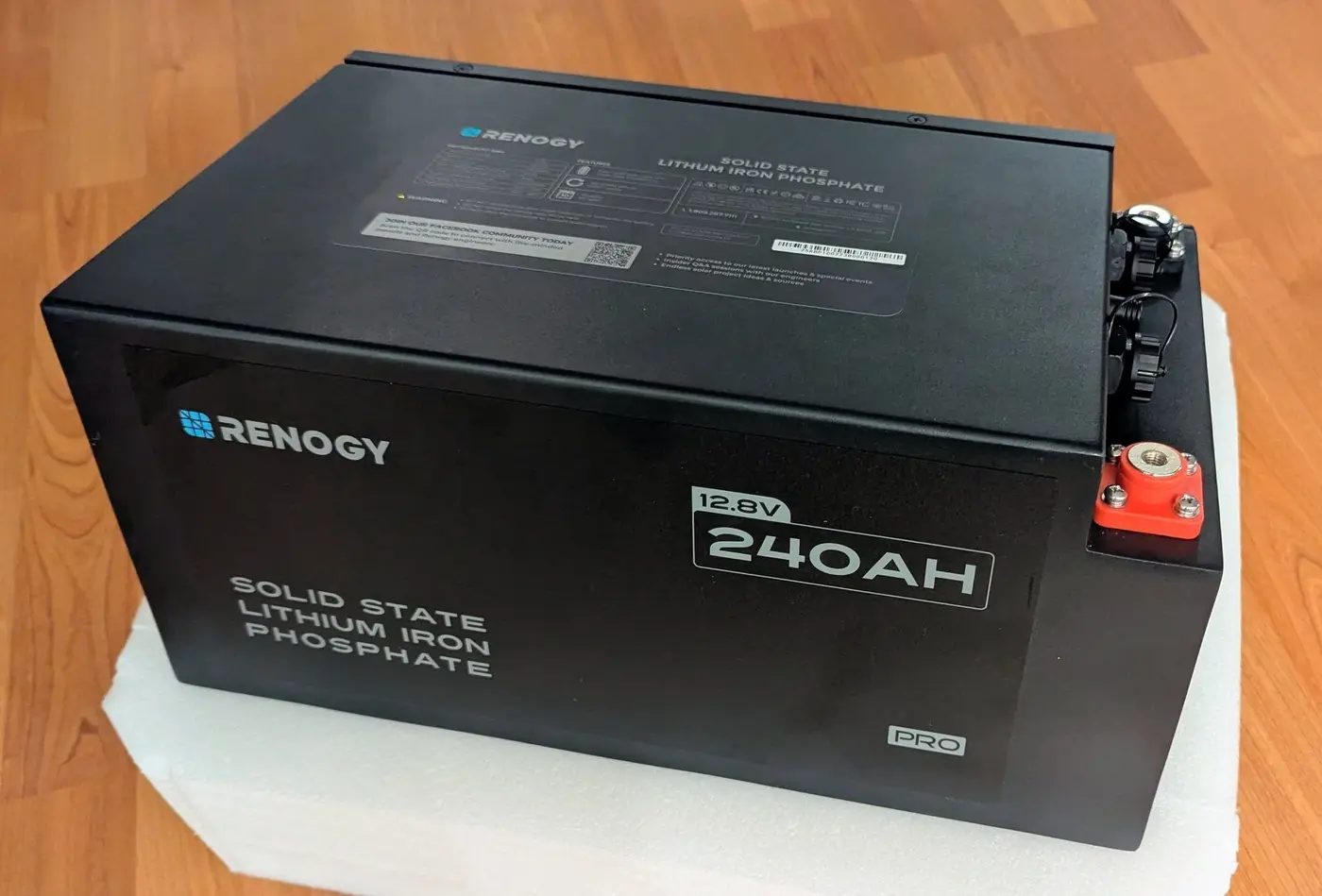
- Cold charging: LiFePO4 cells shouldn't be charged below the manufacturer's permitted temperature. Some models go further: Renogy currently sells a 200Ah Pro and a 300Ah Core with automatic self-heating to warm the cells in cold conditions. That is different from a low-temperature cut-off, so check the exact model rather than assuming every Renogy battery includes a heater.
- Charging compatibility: make sure the DC-DC, solar and mains chargers have settings suitable for the battery.
- BMS limits: if you're running a large inverter, check continuous and surge current instead of assuming a big Ah rating can handle it.
So what size LiFePO4 battery do you actually need?
Work out what you use in a normal day first. Then decide how long you want the system to cope when solar is poor or the vehicle isn't moving. After that, look at how much you can realistically put back through solar and DC-DC charging.
For a basic fridge setup, the answer may still be 100Ah. For a touring setup with more gear and longer stops, 200Ah is often a comfortable step up. If you're running genuinely heavy loads or want several days of reserve, 300Ah or more can make sense. There's no prize for carrying battery capacity you never use.
Put your appliances, battery chemistry, solar conditions and driving into the AMP'D 12V calculator and it will size the battery, solar and DC-DC as one system rather than three separate guesses.